Will an Ice Age Happen Again
Roughly every two years we're treated to headlines repeating the myth that Earth is headed for an imminent "mini ice age." It happened in 2013, 2015, and again merely recently at the tail end of 2017.
This time around, the myth appears to have been sparked past a Sky News interview with Northumbria Academy mathematics professor Valentina Zharkova. The story was rapidly echoed by the Daily Mail service, International Business Times, Sputnik News, Metro, Tru News, and others. Zharkova was too behind the 'mini ice age' stories in 2015, based on her research predicting that the lord's day will before long enter a quiet phase.
The most important takeaway bespeak is that the scientific inquiry is articulate – were one to occur, a yard solar minimum would temporarily reduce global temperatures by less than 0.3°C, while humans are already causing 0.two°C warming per decade.

So the sun could only offset at nigh 15 years' worth of human-acquired global warming, and once its repose phase ended, the sunday would and then assistance accelerate global warming once over again.
The 'mini ice age' misnomer
The myth ultimately stems from a period climate scientists have coined "The Little Ice Age" (LIA). This was a modestly absurd period running from about the twelvemonth 1300 to 1850. It was particularly common cold in the UK, where the River Thames sometimes froze over, and 'frost fairs' were held.
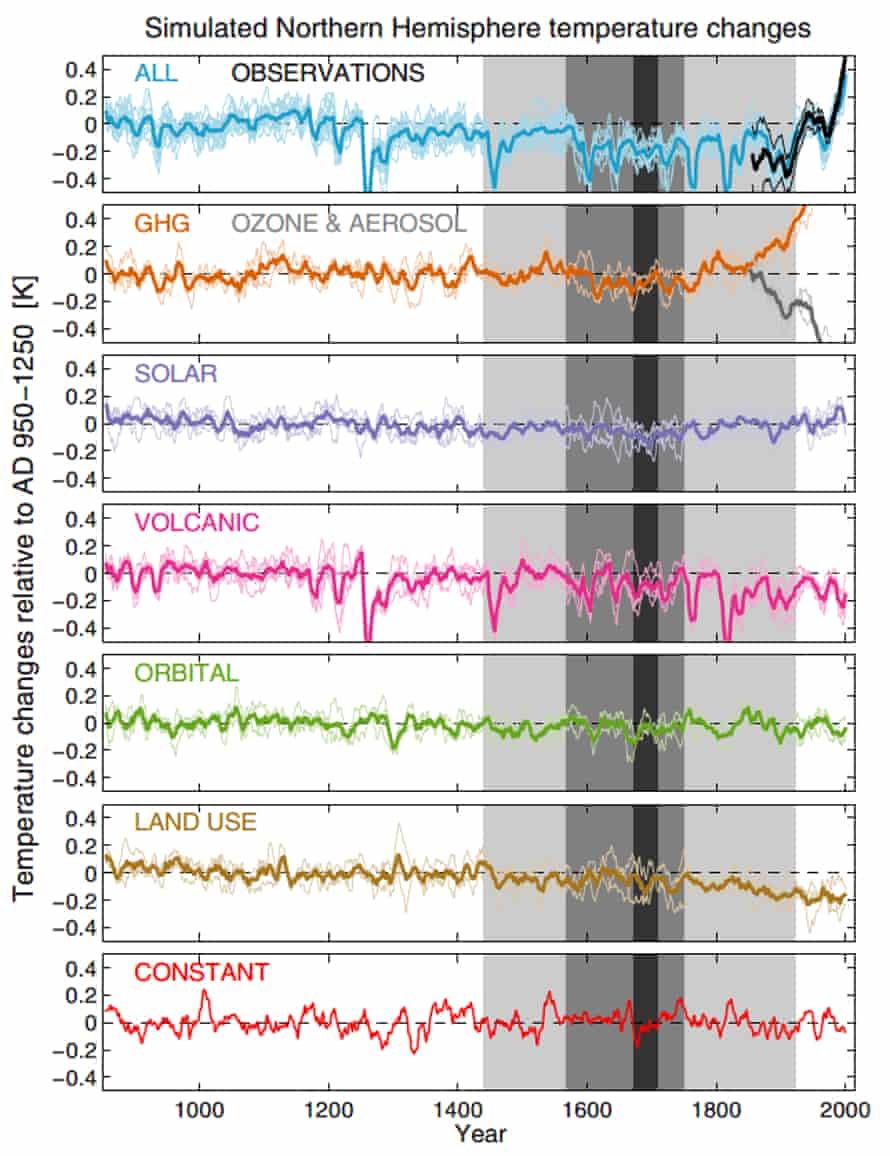
A team led by University of Reading physicist and solar proficient Mike Lockwood wrote a newspaper reviewing the science behind frost fairs, sunspots, and the LIA. It included the figure below showing northern hemisphere temperatures forth with sunspot number and the level of volcanic particles in the atmosphere over the past millennium:

During full blown ice ages, temperatures have by and large been 4–8°C colder than in modernistic times. As this figure shows, during the LIA, temperatures were at most only virtually 0.v°C libation than the early 20thursday century. Thus, Lockwood calls the Little Ice Age "a total misnomer." As the authors put it:
Compared to the changes in the proper ice ages, the and then-called Little Ice Age (LIA) is a very short-lived and puny climate and social perturbation.
For comparison, temperatures have risen by a full 1°C over the past 120 years, and 0.vii°C over just the by 40 years.
The minimal solar minima influence on the climate
The Maunder Minimum was a period of serenity solar activeness between about 1645 and 1715. It's often referred to interchangeably with 'Little Water ice Age,' merely the latter lasted centuries longer. In fact, three separate solar minima occurred during the LIA, which also included periods of relatively higher solar action. Other factors like volcanic eruptions and human being activities as well contributed to the cool temperatures. In fact, a 2017 paper led by the University of Reading's Mathew Owens concluded:
Climate model simulations advise multiple factors, particularly volcanic activity, were crucial for causing the cooler temperatures in the northern hemisphere during the LIA. A reduction in full solar irradiance probable contributed to the LIA at a level comparable to changing state use [by humans].
Several studies have investigated the potential climate impact of a future grand solar minimum. In every case, they have concluded that such a quiet solar menses would cause less than 0.3°C cooling, which every bit previously noted, would temporarily outset no more than than a decade and a half's worth of human-caused global warming. These model-based estimates are consequent with the amount of cooling that occurred during the solar minima in the LIA.
Is another grand solar minimum imminent?
Although it would have a relatively pocket-sized affect on the climate, information technology's withal an interesting question to ask whether nosotros're headed for some other quiet solar period. Zharkova thinks so. Her team created a model that tries to predict solar activity, and suggests some other solar minimum will occur from 2020 to 2055. However, other solar scientists have criticized the model equally existence likewise simple, created based on but 35 years of data, and declining to accurately reproduce by solar activity.
Ilya Usoskin, caput of the Oulu Catholic Ray Station and Vice-Director of the ReSoLVE Eye of Excellence in Inquiry, published a critique of Zharkova'due south solar model making those points. Nearly importantly, the model fails in reproducing by known solar activity considering Zharkova's squad treats the sun as a uncomplicated, anticipated organization like a pendulum. In reality, the sun has more random and unpredictable (in scientific terms, "stochastic") behavior:
For case, a perfect pendulum – if you saw a few cycles of the pendulum, you can predict its behavior. Nevertheless, solar activity is known to be non-stationary process, which principally cannot be predicted (the prediction horizon for solar activity is known to be 10-xv years). Deterministic prediction cannot be made considering of the essential stochastic component.
Merely imagine a very turbulent menses of water in a river rapid, and you throw a small wooden stick into h2o and trace it. Then you lot practise it second fourth dimension and 3rd time ... each time the stick will terminate up in very different positions after the same time period. Its motility is unpredictable because of the turbulent stochastic component. This is exactly the situation with solar activeness.
Lockwood agrees that nosotros don't however have a proven predictive theory of solar beliefs. He has published research examining the range of possible solar evolutions based on by periods when the Sun was in a like land to today, but as he puts it, "that is the all-time that I recall we tin do at the present time!"
Solar physicist Paul Charbonneau at the University of Montreal likewise concurred with Usoskin. He told me that while scientists are working to simulate solar action, including using simplified models similar Zharkova's,
on the standards of contemporary dynamo models theirs is extremely simple —in fact borderlining simplistic ... To extrapolate such a model outside its calibration window, you lot need an extra, very strong hypothesis: that the concrete systems underlying the magnetic field generation retain their coherence (Phase, amplitude, etc.). As my colleague Ilya Usoskin has already explained, this is very unlikely to be the case in the case of the solar activity cycle.
Why won't this myth dice?
Zharkova believes her solar model is correct, but at best it can simply try to predict when the adjacent serenity solar period volition occur. Its influence on Earth's climate is outside her expertise, and the peer-reviewed research is clear that information technology would be a minimal impact.
Zharkova disagrees – I contacted her, and she told me that she believes a m solar minimum would have a much bigger cooling event. Even so, she besides referenced long-debunked myths nearly global warming on Mars and Jupiter, and made a comment about "the preachers of global warming." She'southward clearly passionate about her research, and has the credibility that comes with publishing peer-reviewed studies on solar activity. Peradventure these factors motivate journalists to write these frequent 'mini water ice age' stories.
But Zharkova'due south climate science beliefs are irrelevant. While she has created a model predicting an imminent period of placidity solar activity, other scientists have identified serious flaws in the model, and in whatever case, research has shown that another solar minimum would only accept a small and temporary bear on on Earth's climate.
Source: https://www.theguardian.com/environment/climate-consensus-97-per-cent/2018/jan/09/the-imminent-mini-ice-age-myth-is-back-and-its-still-wrong
0 Response to "Will an Ice Age Happen Again"
Postar um comentário